Buck Rivets
Doug takes on an Airstream repair and channels his inner assembly line worker

Previously on Between Corners: A surprise guest shows up at Charlotte’s workplace.
Charlotte strolled out mid-morning with a cup of coffee. I was inside a 2013 Airstream Bambi, drilling out pop rivets with a cordless drill and a 1/8” drill bit. Occasionally I swapped out the drill bit for a Phillips-head driver to back out a screw.
I saw her come in.
“This is all you need to take these things apart,” I said as I tried to pry a cabinet loose. “A drill bit and a #8 driver head.”
The cabinet snagged on something. There was always a hidden rivet.
“Well,” she started. “So far so…good?”
“Seems like it. The only rub is that these things were not built to be taken apart. Takes some care. But I’m almost there with this side of things.”
“If you say so…”
Charlotte set the coffee on the dinette. “Take a break?”
“Give me a sec…”
I grunted as I muscled the cabinet. Then I saw the offending rivet.
“Can you grab that?” I asked, pointing to the floor, where I had put my multi-tool with its metal-cutting blade.
“This?”
“Yes. See that rivet there?” I pointed to the bottom of the cabinet. “Turn the multi-tool on and cut that rivet.”
She pushed the “on” switch. The tool buzzed loudly.
It was a heavy device. But maybe the most useful tool I had. I called it my “get out of jail free” tool.
With a little caution, she pushed it against the recalcitrant rivet. The blade caught and I saw her hand jerk a little. Then the rivet snapped.
“Whew,” I said. “Thanks.”
The cabinet swung free.
This whole adventure had begun two weeks earlier.
We were watching TV when my phone chimed. I glanced at it. Took a minute to clock what the text was saying.
“Oh, brother,” I said. “Get this.”
“What?”
“Some guy in Dallas. He knows someone who knows someone who knows I work on Airstreams. Look.”
I handed her my phone. The photo showed an Airstream newer than my ’79. Blunter, flatter on top. It had an enormous dent on its right front quarter panel. Its forehead, if you will.
“It looks like it needs a Band-Aid emoji,” she said.
I laughed.
“This one’s up for auction,” I said. “Guy’s thinking of bidding twelve grand. Wants to know what a repair would cost.”
“What do you think?”
“Hard to say. To reach the outside panel, all the cabinets and interior walls behind it have to come out. That’s a lot of work. But once you’re there, the new panel goes in pretty easily. You just buck-rivet it into place.”
“Buck rivet?”
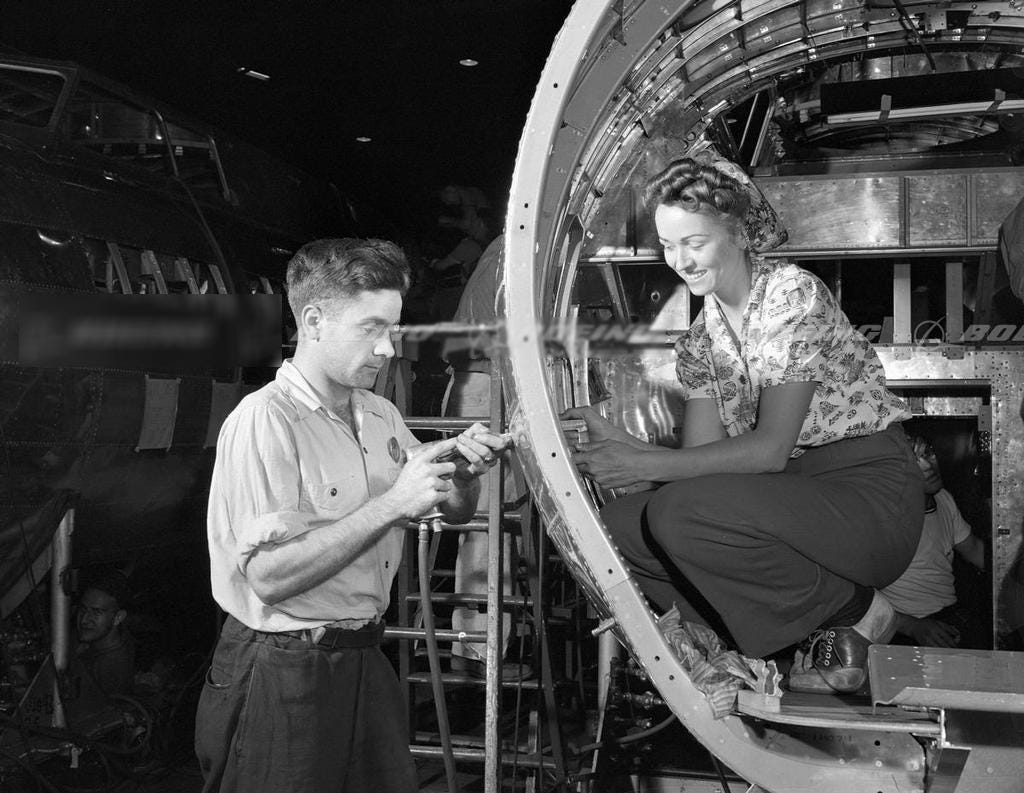
“Old school. How Boeing used to build bombers. Rivet goes in the hole. One person runs an air hammer. The other holds a bucking bar on the back side. The bucked rivet end expands and locks against the sheet metal.”
I gave her a nudge. “That part takes two people. You in?”
She looked at the picture and frowned. “I don’t know, Douglas. That sounds like a lot of work. Can you really do this?”
“Oh sure. Nothing’s ever easy, but it’s doable.”
I opened my calculator. “Fifteen thousand for the repair. After that, the trailer’s probably worth forty, maybe forty-five. Interior’s fine.”
“So…?”
“I’m going to say yes.” I started a text. “Main thing is whether he can deliver it. I’m not taking that on too.”
In 10 minutes, my phone chimed again. I looked at it.
“He’s in,” I said to Charlotte. “Trailer will be here Saturday.”
She rolled her eyes like she does when she thinks I am nuts. Which is often. “I hope you know what you’ve gotten yourself into.”
“Yeah, sure, hell, easy,” I said.
She punched me.
“Ow,” I said.
As promised, the trailer arrived Saturday afternoon, towed behind an F-250 belonging to a Dallas architect named Mark Murray.
The two of us looked the Bambi over. I described the repair process, gave him a tour of my own trailer. “Very nice,” he said.
We went into the house. Charlotte poured iced tea while Mark and I discussed the contract. Replace bad panel, restore interior to original condition after removing cabinets and walls to gain access to the exterior. $15,000, flat price. I had figured 125 hours, more or less. So, $120 an hour for me. Still a lot less than what Airstream DFW, the Airstream big dealer near Fort Worth, would charge.
Mark signed the contract, hopped into his truck, and drove off.
We stood outside the house and watched him go.
“Well then,” I said to Charlotte. “I’ll start tomorrow.”
“But…” she started. “What about the barn siding?”
I had promised her I’d fix it.
“I’ll get to it,” I said.
She blew at a stray hair that had fallen over her face.
By the next Wednesday, I had the cabinets out and the interior walls removed. I set up a ladder on the outside, and with a hammer and punch struck a dent in each smooth exterior rivet. Deep enough so a drill bit would not skid off. Then another round of drilling to take them out. In the end, the dented panel came off easily.
I had bought a replacement panel from an Airstream parts vendor. It was pre-drilled for rivets, but of course two of the holes didn’t quite line up.
Charlotte had come out to watch. And we were going to do some buck riveting.
“It’s OK,” I said to her as I fitted the new panel. “Some of the rivets won’t be perfectly aligned. But there are so many, no one will tell. Well…hardly anyone.”
I looked at her and smiled. “Now, my bucking-bar holder. You’re up.”
We practiced first, on some scrap aluminum clamped in a vise on a temporary workbench near the trailer. I drilled a hole, slid in a mushroom-topped rivet. She held the small metal bar with an odd assortment of ends and contours – to fit into tight spaces.
We both donned safety glasses. She pressed the bar against the back side of the rivet and watched as I held the air hammer to the other side and pulled the trigger.
A loud “Brrrrrruuuppppp!!”
The hammer jerked spasmodically in my hand, with a strange, almost liquid feel.
I pulled the hammer away and looked at her side.
“Close,” I said. “Hold the bar a little more firmly.”
We tried again.
I looked again, pleased. “You’ve got it.”
Then it was Charlotte inside the trailer, me on a ladder outside. I’d stick a rivet through a hole in the panel, yell “Ready!” and on the opposite side she would brace the bar while the gun hammered against it.
It was kind of fun.
I had about 20 rivets in when something didn’t feel right. The gun felt mushy, and the rivet was dimpled. No good.
“Dammit.”
I went inside to look at the rivet.
“Charlotte, you had the bar crooked,” I said, pointing to her end of the rivet. “Now the outside one is dimpled. I’ll have to drill it out and start over.”
“Sorry,” she said.
I made an exasperated sound.
“Why don’t you go make us some coffee?”
I didn’t look at her.
“I have a better idea,” she said. Her voice had an edge. I knew the tone.
“Find someone else to help with your rivets.”
Then she turned and walked to the house.
“Charlotte…” I tried to say.
As she walked her phone chimed. I saw her look at it. She smiled.
That was odd.
Then she was gone.
Now what. It hadn’t been her fault – I should have kept my mouth shut and I knew it. I debated going inside and trying to patch things up. But I decided maybe it was best to let her cool off.
I sat at the dinette and thought for a minute. Then I called my friend Jeff. He was handy with tools – he built sculptures he took to Burning Man every year. I had tried to join him one year on my way home from some time in the Grand Canyon but when I got to the little town of Gerlach it was so hot, so windy, and so dusty that I just kept driving.
“Hey buddy,” I said. “You got an hour to spare this afternoon? You do? I could use a spare pair of hands. Great. Thanks!”
Jeff came by at 2.
Charlotte brought coffee out. For him.
“Hello Jeff – how are you?” she said.
He took the coffee from her and gave me a look. I gave him a slight eyeroll that she almost caught.
Jeff understood. He and his wife Marianne were mirror images of me and Charlotte. I often joked with him that we were both acting in the same sitcom – we were just on different sound stages.
We had the rest of the rivets installed within the promised hour. He dimpled one, too.
Two, in fact. I kept my mouth shut. It was harder to get annoyed with friends.
After we finished, we stepped back to admire our work.
“Hey Doug,” Jeff said. “Is it just me, or does that new panel not quite match?”
I looked at it from a few different angles, thinking the light was playing tricks. But he was right.
“Different production run for the aluminum?” I said. “Different alloy? It’ll weather in after a while. I think.”
“Will the guy mind?”
“He shouldn’t. It hardly shows. And I’m charging him about half what the Airstream shop in Dallas would ask.”
I shrugged. “Gives it character, in my opinion.”
Jeff was doubtful. “Character.”
Finishing the job took two more weeks. I blew past my 125-hour estimate so fast I heard a whooshing noise.
I finally got to the barn work, along with client projects. Mark called once or twice as the initial deadline slipped.
“Close!” I’d say. “Just getting the inside cabinets back in.”
Of course, that wasn’t easy. I had broken one while removing it. I had to splice in new wood to reinforce a fracture in a cabinet adjacent to the new exterior panel. The patch didn’t quite match. More problematic, the cabinet refused to align exactly with its original position.
I was wrestling with that when Charlotte looked inside.
“I’m going to the store. Need anything else on the list?”
“I don’t think so. Maybe tonic water.”
“OK.”
She took everything in.
“Well?”
“I think we’re OK,” I said. “Not perfect, but close. Mark will understand. Still a damn nice trailer for the money.”
But when Mark arrived to tow the trailer home, he wasn’t so sure.
“Panel doesn’t match,” he said, running a hand along the exterior. “These two rivets don’t line up.”
I could only nod. “Understood,” I said.
Inside, it got worse.
“This cabinet doesn’t align,” Mark said. “And you can see old rivet holes under what looks like putty. I’d hoped for better.”
I tried to explain the challenge. Not a straight line in an Airstream. Built with a thousand small, light parts rather than a few heavier ones, like a house.
“I was told you knew these things,” Mark said. “Now I’m not so sure.”.
“I do know, Mark,” I said, trying to say evenly. “There are always surprises.”
“Not ones I should pay for,” Mark replied.
We negotiated. I knocked three thousand dollars off his fee.
I was down to $40 an hour for my effort.
We shook hands. The trailer was hitched, then disappeared down the highway.
“Well,” I said to Charlotte. “Nothing is easy.”
“You’re OK with getting three thousand less than you expected?”
I shrugged. “I guess. I hadn’t really done this before. So he paid me to learn something. If I get a few bucks less, so it goes.”
“If you say so,” she said.
She glanced at the still-unpainted barn siding.